

Macedonian Grayling | Pseudochazara cingovskii (Mike Watson)
LESS THAN 10 SQ KM. This is the astonishingly tiny extent of the known global range of the Macedonian Grayling Pseudochazara cingovskii. It is regarded as Europe’s most critically endangered butterfly. (Nogel’s Hairstreak Tomares nogelii has an even smaller range within Europe, but it occurs more widely beyond). The ultra-rare grayling was only described as a new species in 1978 and named in honour of Dr Jonče Cingovski, a Macedonian entomologist. It was previously treated as a subspecies of Pseudochazara sintenisi.
Although capture and export for commercial purposes have been prohibited in North Macedonia since 2011, illegally collected specimens still apparently appear for sale online in Europe. With North Macedonia outside the EU, enforcement of its protected status is likely more challenging. If one must collect things, why not buy stamps depicting it online, as I did.
Macedonian Grayling | Pseudochazara cingovskii (and Balkan Clouded Yellow | Colias caucasicus balcanica) (Mike Watson)
A more immediate and severe threat to this remarkable butterfly is habitat destruction from marble quarrying. Vast sections of limestone scree have already been removed. I have never seen anything quite like it: the stark white quarry scars are visible from outer space. Fortunately, the species still persists in patches of flower-rich, relic limestone pavement in the Prilep district of North Macedonia.
Janó had become concerned that the butterfly might have been collected out of its principal sites, having failed to find it on his last three attempts. Given that he is one of the best finders of rare creatures I know — whether birds, mammals, or insects — this was worrying. Perhaps time was ticking away for Macedonian Grayling more quickly than I had realised. So we did some research. Janó had seen it during the second week of July, and his subsequent visits were at similar dates. References list the flight period as late July to early August (Collins Guide, 2008) and July to August (Princeton Guide, 2026). However, interestingly, Naturetrek reported not missing the species in five visits between 2018 and 2025 on their “Butterflies & Birds of North Macedonia” tour, with sightings ranging from 20–29 June. There are also recent late June records on Inat.
Was Janó simply searching too late in the season? Was his earlier success a result of an unusually late emergence year? Or is the flight period shifting earlier altogether? These were the questions we wanted to explore on our whistle-stop tour of some of the Balkans’ most elusive butterflies. We selected 21 June — We assumed this would be the start of the flight period. We also knew that, in Greece at least, many butterflies had emerged slightly earlier than usual this year.
We began at the classic, well-documented site. All known localities from a 2012 survey are available online. We arrived on a bright, sunny morning with almost no cloud and a pleasantly cool 17°C. After a short walk through a flower-rich upland meadow, we reached the limestone scree. Within minutes: BAM! Janó called out, “Maccy G!” while I was distracted photographing a Great Sooty Satyr Satyrus ferula.
János Oláh photographing Macedonian Grayling (Mike Watson)
Macedonian Grayling | Pseudochazara cingovskii (Mike Watson)
The Macedonian Grayling behaves like a classic grayling: it usually retracts its forewings on landing and angles its body perpendicular to the sun. This leaves little time to photograph the striking paired white forewing spots, and even less chance of open-wing shots. I focused instead on in-habitat images with natural backgrounds, though even this was tricky — they do not always settle in convenient positions.
In the cool early morning they were still sluggish, just warming up. As the morning progressed they became increasingly active and difficult to follow. Once the sun climbed higher, the glare from the limestone made photography even harder. Early morning was clearly essential.
Macedonian Grayling | Pseudochazara cingovskii (Mike Watson)
Macedonian Grayling | Pseudochazara cingovskii (Mike Watson)
We spent a couple of hours at Site A and counted at least 15 individuals in a relatively small area; the earlier survey findings suggested the species is highly sedentary, even in continuous habitat. Also present was the fast-flying Eastern Greenish Black-tip Euchloe penia, which rarely settles long enough for a proper look. The graylings were pristine — freshly emerged, clearly at the very start of their flight period. Another butterfly dream realised. It was time for our pastry club to find a local пекара (pekara = bakery).
Macedonian Grayling | Pseudochazara cingovskii (Mike Watson)
Macedonian Grayling | Pseudochazara cingovskii (Mike Watson)
Macedonian Grayling | Pseudochazara cingovskii (Mike Watson)
Eastern Greenish Black-tip | Euchloe penia (Mike Watson)
Macedonian Grayling habitat near Prilep (Mike Watson)
Fuelled up, we moved on to a backup site. Driving through a heavily altered landscape — past stacks of 2–3 metre marble blocks — we eventually reached a more remote location. A grassy meadow here produced the striking Sinuated Spoonwing Nemoptera sinuata, a surreal, long-tailed Balkan insect. From there we reached another limestone pavement, part of a much larger site that had recorded the highest numbers of Macedonian Graylings in the 2012 survey. Yet despite this, we found only two individuals across a wide area. Temperatures had now exceeded 30°C, and butterfly activity had dropped sharply.
The only abundant species was the Great Banded Grayling Hipparchia semele, present in what were uncountable numbers. Eventually, we moved on — mission accomplished. On the way back, we disturbed a robber fly carrying a freshly killed Delattin’s Grayling Hipparchia volgensis. We managed to retrieve it briefly for a closer look, particularly the upper wing surfaces. We had also seen another individual at Site A, though not the upper wings clearly.
Macedonian Grayling | Pseudochazara cingovskii at Site B (Mike Watson)
Macedonian Grayling habitat at Site B (Mike Watson)
The Hermit, Chazara briseis, also appeared. An oddly named butterfly, the origin of its name is uncertain. British literature from the 19th century refers to it in that form, during a period when species were often called The something or other. It spends its life in recluse in remote rocky places or its behaviour, retreating into crevices or juniper edges, perhaps explains the association. We watched it repeatedly slipping into cover, possibly influenced by the extreme heat. It will be interesting to see how it behaves under cooler conditions in future.
We had learned enough about the Macedonian Grayling for now. With the afternoon ahead of us, it was time to move on to another species whose fragmented range just reaches into the Balkans…
The Hermit | Chazara briseis (Mike Watson)
The Hermit | Chazara briseis (Mike Watson)
Delattin’s Grayling | Hipparchia volgensis (Mike Watson)
Delattin’s Grayling | Hipparchia volgensis - dead (Mike Watson)
Great Sooty Satyr | Satyrus ferula (Mike Watson)
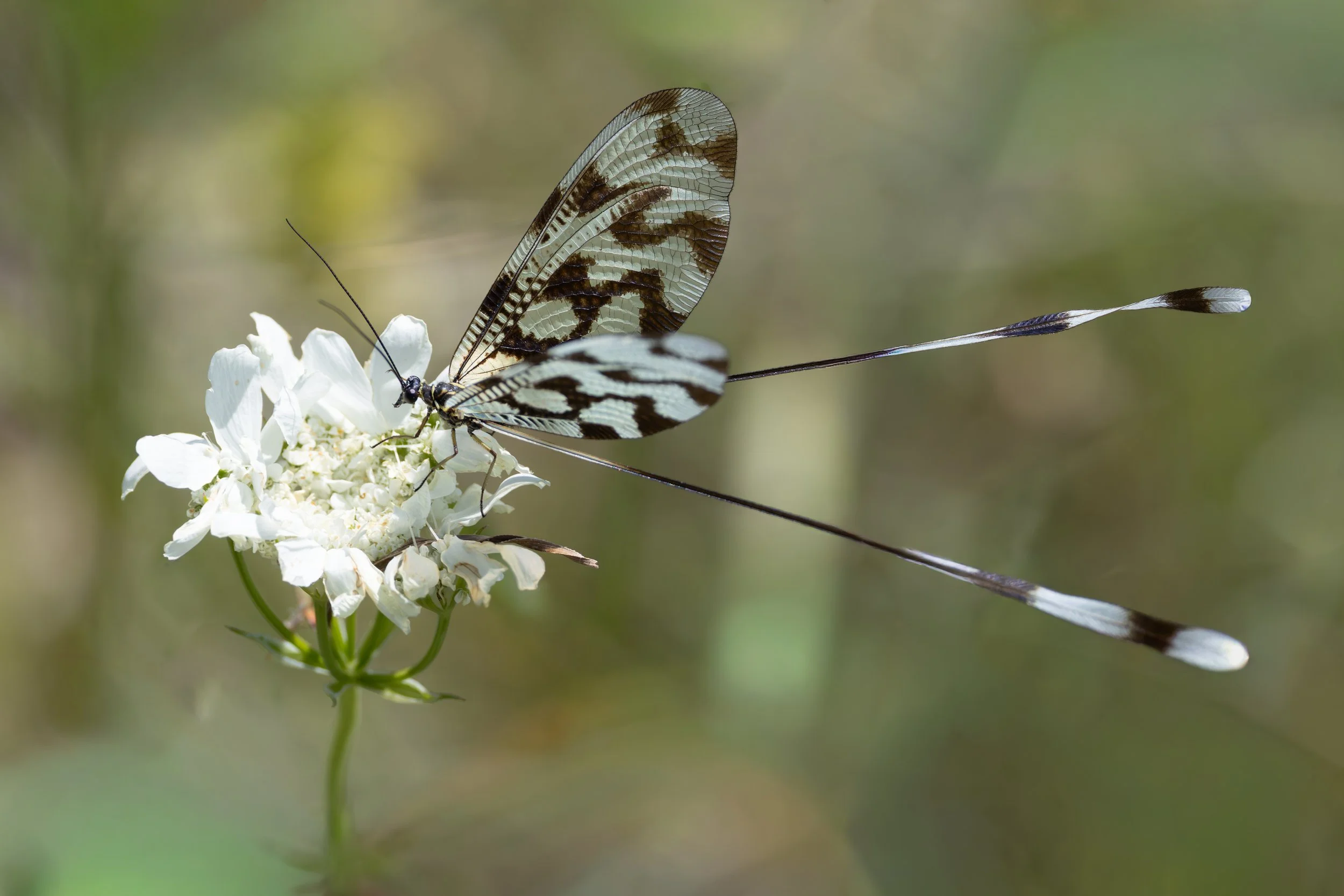
Sinuated Spoonwing | Nemoptera sinuata (Mike Watson)
Marble Quarry near Prilep, habitat eliminated (Mike Watson)
Marble Quarry near Prilep, a scene of devastation (Mike Watson)