
African Savanna Elephant, Onguma Private Wildlife Reserve (Mike Watson)
Etosha is a true bucket-list destination, particularly for anyone with an interest in African wildlife. Like many wildlife enthusiasts, I had wanted to visit for years. The images of that enormous, almost impossibly white salt pan had lodged themselves in my imagination long before I ever set foot there on my recent Wild Images tour.
The Etosha Pan covers around 4,800 square kilometres and is so vast that it can be seen from space. Staring into it is an extraordinary experience. The whiteness stretches away to the north into a bright, almost horizonless void, and it is strangely disorientating to watch an ostrich or giraffe walk towards it, apparently heading into nothing.
Etosha is also famous for its remarkable populations of large mammals. The most recent census figures I could find recorded 2,911 African Savannah Elephants, 1,280 Black Rhinos, 14,232 Burchell’s Zebras, 10,317 Springbok, 4,108 Southern Oryx, 4,207 Blue Wildebeest and 3,172 Angolan Giraffes. All of this wildlife occupies an area of almost 23,000 square kilometres; the size of Wales.
The predators, naturally, are rather less numerous. Despite plenty of searching, most of us managed only Lion and Black-backed Jackal, although Gin had a brief Cheetah sighting. We received little help from the rather secretive local guide network, who seem reluctant to share their discoveries. Perhaps that is no bad thing for the animals, given that almost 400,000 visitors now pass through Etosha each year.
But for us, the real magic of Etosha happened at its waterholes.
Blue Wildebeest approach cautiously at the Onkolo Hide (Mike Watson)
THE ONKOLO HIDE
There are countless waterholes in and around Etosha National Park, and we were extraordinarily fortunate to spend much of our time beside one of them, in what may be one of the best waterhole photography hides in Africa.
The Onguma Private Game Reserve sits just outside the national park, away from much of the visitor traffic. Sunk into the white earth beside a waterhole, the Onkolo Hide gives you a remarkably intimate, almost water-level view of the animals coming to drink.
Our encounters there easily surpassed almost everything else we experienced in Etosha. The only real contenders were the extraordinary lion encounter and perhaps the nocturnal rhino gatherings at Okakuejo.
What struck me immediately about Onkolo was that every session was different. There were no repeat performances. I am not sure we saw the same individual animal twice. Everything seemed to be passing through, stopping briefly for a drink before continuing on their way.
A fence separates Onguma from the national park, but elephants apparently have a habit of pushing it over. If you own a private game reserve next to a national park, I suppose there is little incentive to spend too much time repairing a hole in a fence that brings more wildlife to you.
One moment we were sitting quietly in the hide; the next, a shadow appeared in the corner of my eye.
I looked up.
An enormous bull elephant was towering over us.
We enjoyed several elephant visits, each one different from the last. After dusk, a pair of Black Rhinos; a mother and her well-grown calf appeared at the waterhole as the light faded.
The hide is renowned for its views of herbivores, and it certainly lived up to its reputation. Burchell’s Plains Zebras, Blue Wildebeest, Impala, Springbok, Warthogs and, particularly, the magnificent Southern Oryx and Kudu all came to drink. Even a diminutive Slender Mongoose made an appearance.
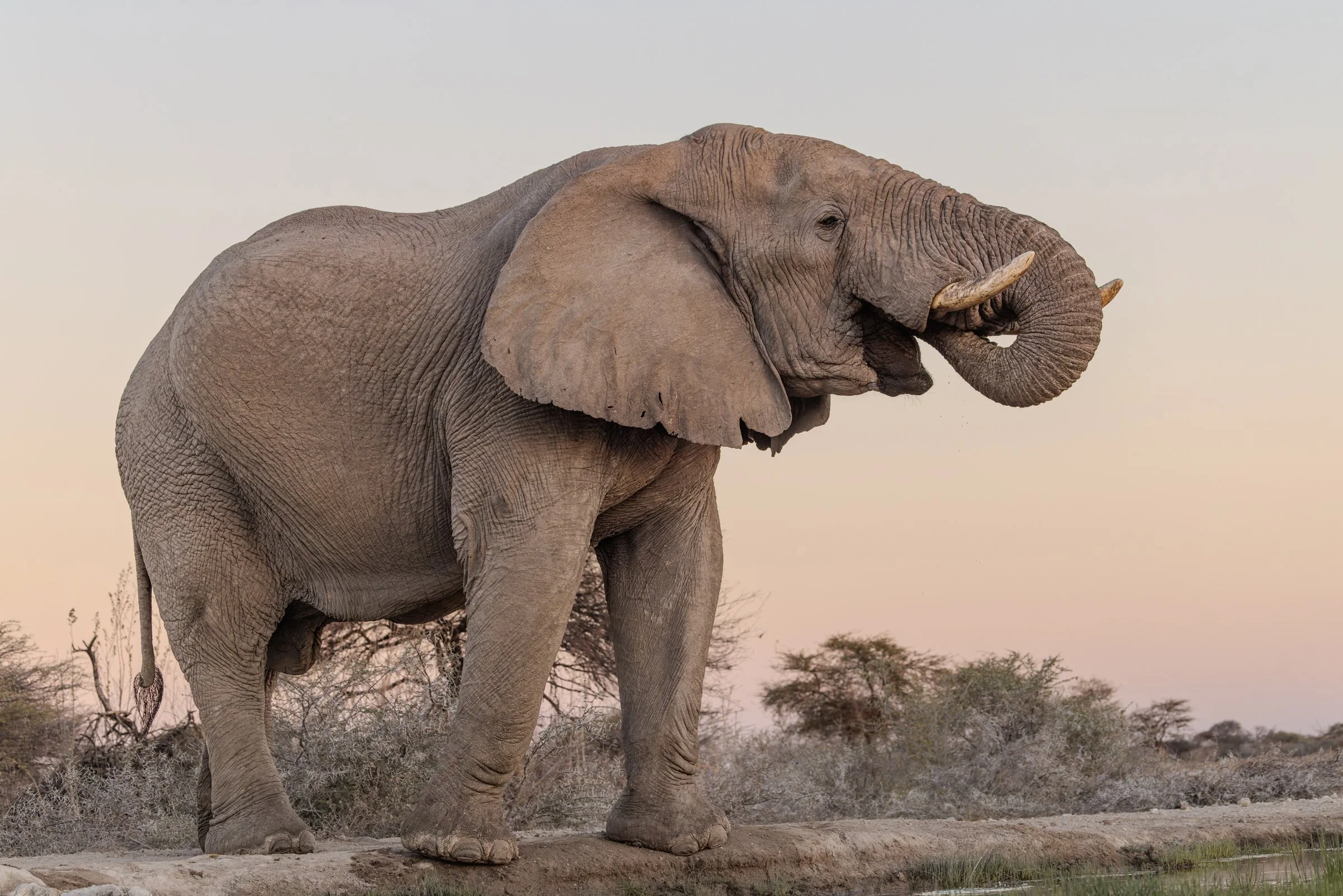
African Savanna Elephant (Mike Watson)
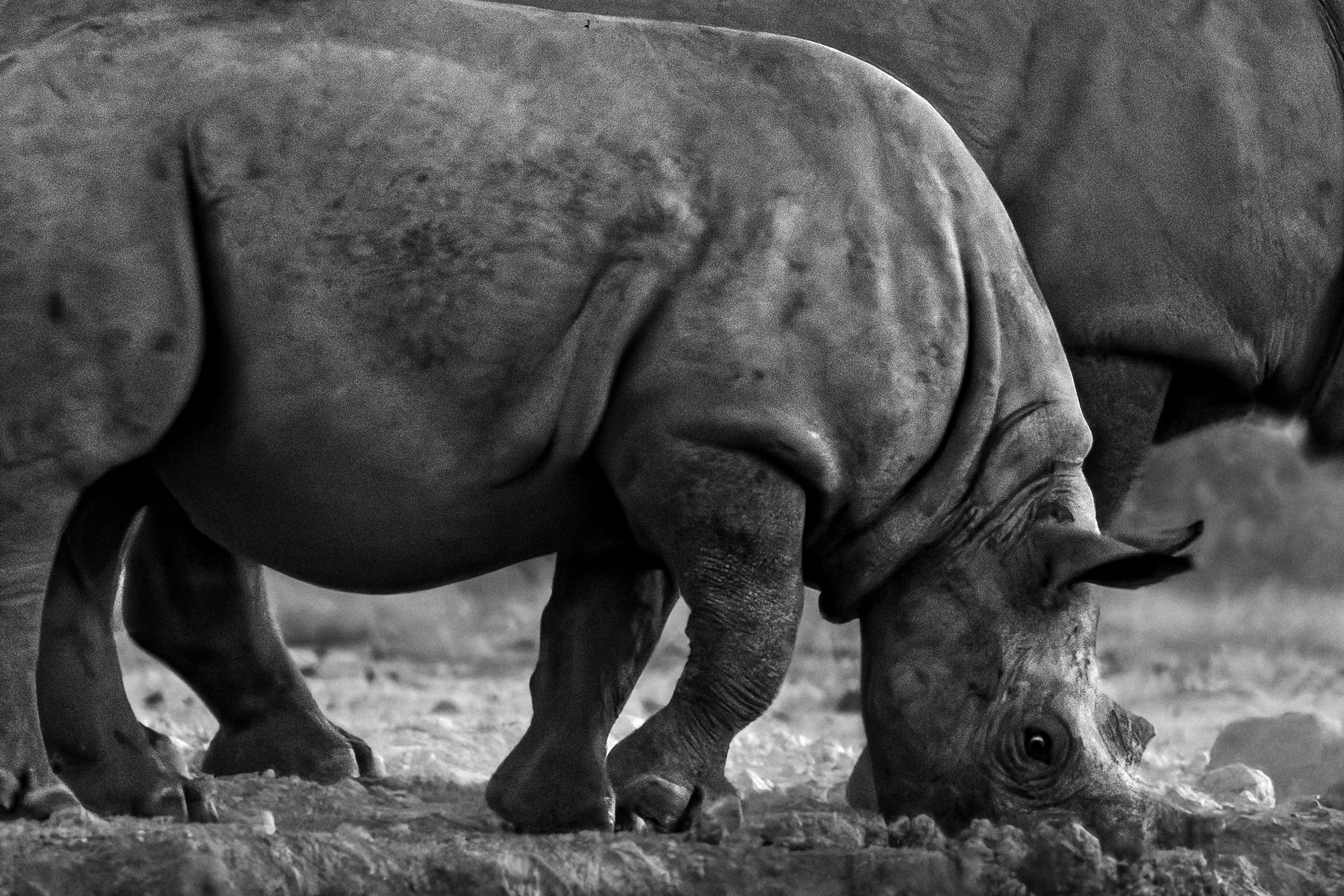
Black Rhino (Mike Watson)
(Burchell’s) Plains Zebra (Mike Watson)
Southern Oryx (Mike Watson)
The birdlife was also entertaining.
Hamerkops worked the shallows, catching tiny invertebrates and occasionally providing those wonderful “between-the-mandibles” photographic moments. A resident pair of Blacksmith Lapwings appeared with their scruffy youngster. There were Kori Bustards, Grey Go-away-birds, Namaqua, Painted and (a single) Burchell’s Sandgrouse, Crested Francolins and, seemingly, an unlimited supply of Helmeted Guineafowl.
Hamerkop (Mike Watson)
The bushes around the hide sheltered drinking passerines, including Blue Cordonbleus, Violet-eared and Common Waxbills and Crimson-breasted Shrikes. Out across the surrounding grassland we saw Angolan Giraffes and Northern Black and Red-crested Korhaans, particularly on our transfers to and from the hide.
After dark, a furtive Spotted Hyaena appeared.
And then there was the Milky Way.
One night we ventured out, and Gin gave us a masterclass in Milky Way photography. It was as spectacular as ever to look up at the night sky and then put binoculars to your eyes and discover just how many more stars are actually there.
There are perhaps 400 billion stars in our own galaxy, the densely-starred centre of which we are looking at.
It puts things into perspective.
We are rather insignificant.
Our stay at the Onguma tented camp itself was a tour highlight. It is a seriously luxurious place; somewhere I imagine Richard Branson would be happy to call home for a few nights. The chalet-like tents surround a delightful waterhole, while the dining area, lounge and open-air fire pit (or boma) provide an excellent place to relax after a day in the park.
Gin at Onguma Tented Camp (Mike Watson)
EASTERN ETOSHA
We spent time exploring the waterholes around Namutoni at the eastern end of the national park, but after Onkolo, the encounters inevitably felt somewhat anticlimactic.
There were Angolan Giraffes, Plains Zebras and elephants, along with a couple of particularly cute Damara Dik-diks. A group of Lions had taken up residence around the Klein Okevi waterhole, but they remained mostly out of sight during the heat of the day.
The evening lion sightings at Onguma were considerably better.
First, a lone female walked along the boundary between the reserve and the seemingly endless sea of grass stretching into the national park. Later, we encountered another female being followed by two males. The males sauntered along behind her, occasionally pausing before continuing their pursuit.
And then they roared.
Hearing Lions at night is a completely different experience. From inside a tent they sound impossibly close, although then camp staff tell you they were half a kilometre away.
These Lions, however, were about 15 metres in front of our vehicle.
The roar was a terrifying, reverberating sound. When the Lion reached the end of its sequence of roars, the finale seemed to come from somewhere deep inside its belly. Nothing else in nature makes a sound quite like it—not even a Tiger.
Southern Lion at Onguma (Mike Watson)
Southern Lion at Onguma (Mike Watson)
THE DUSTY ROAD WEST
Crossing Etosha from east to west was tedious hard work.
There were extensive roadworks, several waterholes were inaccessible, and our mapping app seemed determined to find anything except the shortest route. We eventually encountered a couple of people watching two Black Rhinos, but the animals quickly disappeared into the bush.
That was the highlight of a day spent driving through a dust cloud, while enduring what seemed like at least a million teeth-rattling corrugations.
Eventually, though, relief arrived in the form of a sudden realisation:
We were nearly there.
Okakuejo—the western hub of this part of the national park—was just a few minutes away.
And then the ordeal was over.
Kori Bustards near Namutomi (Mike Watson)
OKAKUEJO AFTER DARK
The tracks around Okakuejo were dusty and corrugated too, and most of the wildlife seemed determined to remain at arms reach.
Nevertheless, we added some worthwhile encounters to our Etosha portfolio: Giraffes and Ostriches silhouetted against the white of the salt pan, a Secretarybird methodically stomping around in search of prey, a feisty little Yellow Mongoose and a Martial Eagle that swooped into a gathering of Guineafowl.
But, the real action began after dark.
Okakuejo’s waterhole is famous for its nocturnal wildlife, and it did not disappoint.
The evening golden hour was interesting enough. Hordes of Helmeted Guineafowl gathered around the water, accompanied by Plains Zebras and Angolan Giraffes against a beautiful sky. Unfortunately, the quantity of dust in the air made the photographs a little soft.
Then came dinner.
Afterwards, we returned to the waterhole to find a crowd gathered around it like spectators at a major sporting event.
We soon discovered why.
On each of the two evenings we spent there, up to eight, or perhaps even nine, impressive Black Rhinos appeared. Some came remarkably close, and under the floodlights they were surprisingly photogenic, despite the challenging combination of high ISO and slow shutter speeds.
There was plenty of interaction between mothers and calves, as well as between individual rhinos. There was pushing, shoving and plenty of snorting.
Magic!
Black Rhinos are essentially bad tempered, grumpy mammals with poor eyesight, and their encounters with the elephants that also arrived after dark were not particularly cordial either.
Black Rhinos at Okakueio Waterhole (Mike Watson)
Spotted Hyaenas and Black-backed Jackals lurked in the shadows, while on the evening we arrived early, hundreds of Double-banded Sandgrouse descended on the waterhole for their own sundowner. They arrived in small groups, drank, and disappeared again into the darkness.
The waterhole after dark was unquestionably one of the highlights of the whole trip.
Our only regret was that we hadn't conserved more energy during the afternoon so that we could have stayed even later to watch the endless comings and goings.
But another busy day awaited us.
Yellow Mongoose, Okakeujo (Mike Watson)
MOVING ON
All too soon, it was time to leave Etosha and head west towards Damaraland.
On the way, we stopped to refuel at one of the few fuel stations operating this year. Then, quite by chance, we came across a crowd of vehicles following the progress of a young male Lion.
I was disappointed to see that he was collared. When he turned side-on, Mike pointed out that the collar was barely visible, but nevertheless it wasn't exactly a photographic opportunity we'd been hoping for.
Still, it seemed an appropriate final Etosha sighting.
The Great White Place had delivered bull elephants towering over us, rhinos drinking under floodlights, lions roaring at point-blank range, giraffes walking into the white void, birds arriving by the hundreds and a night sky containing hundreds of billions of stars.
Not a bad place to tick off the bucket list.
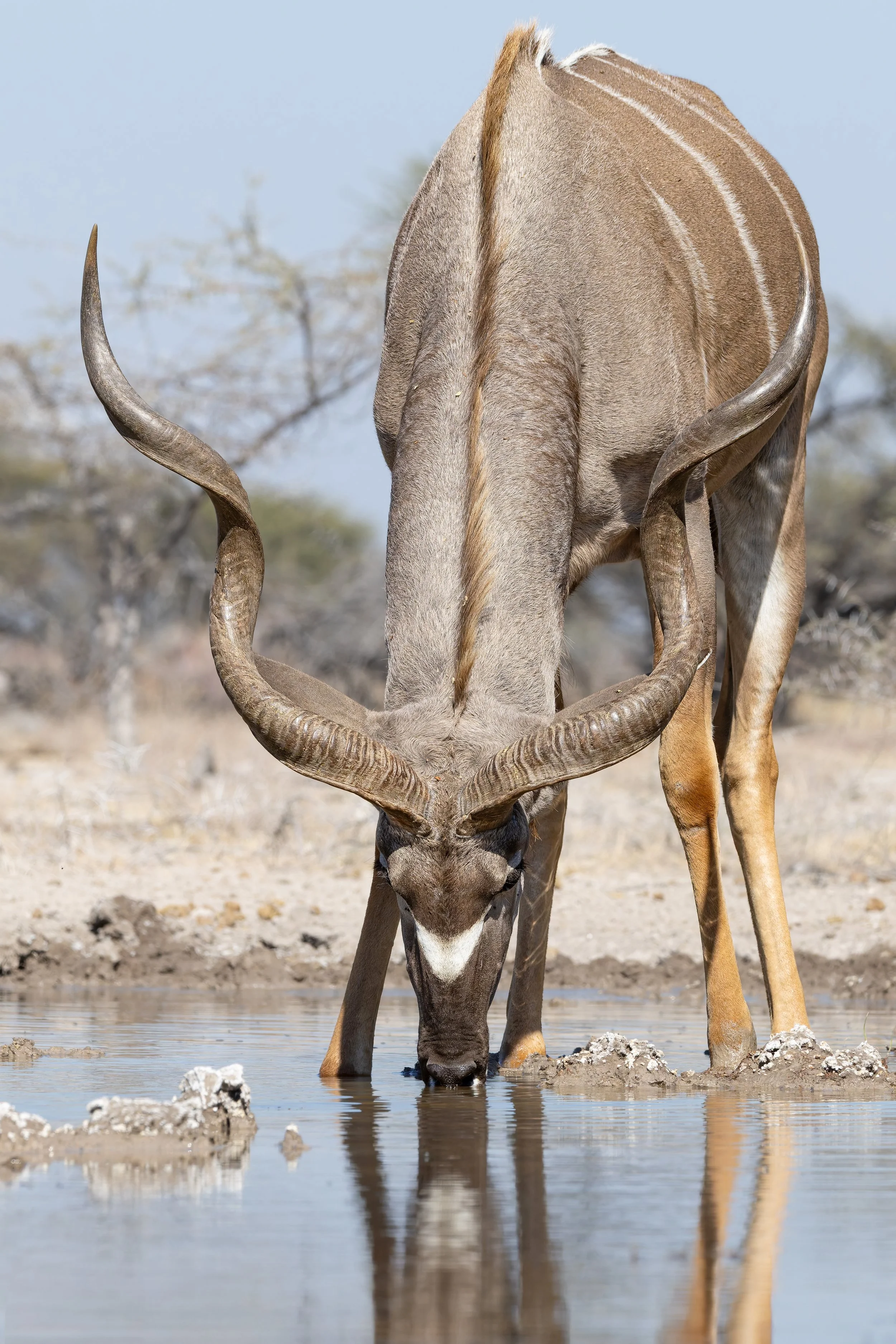
Greater Kudu, Onguma (Mike Watson)