

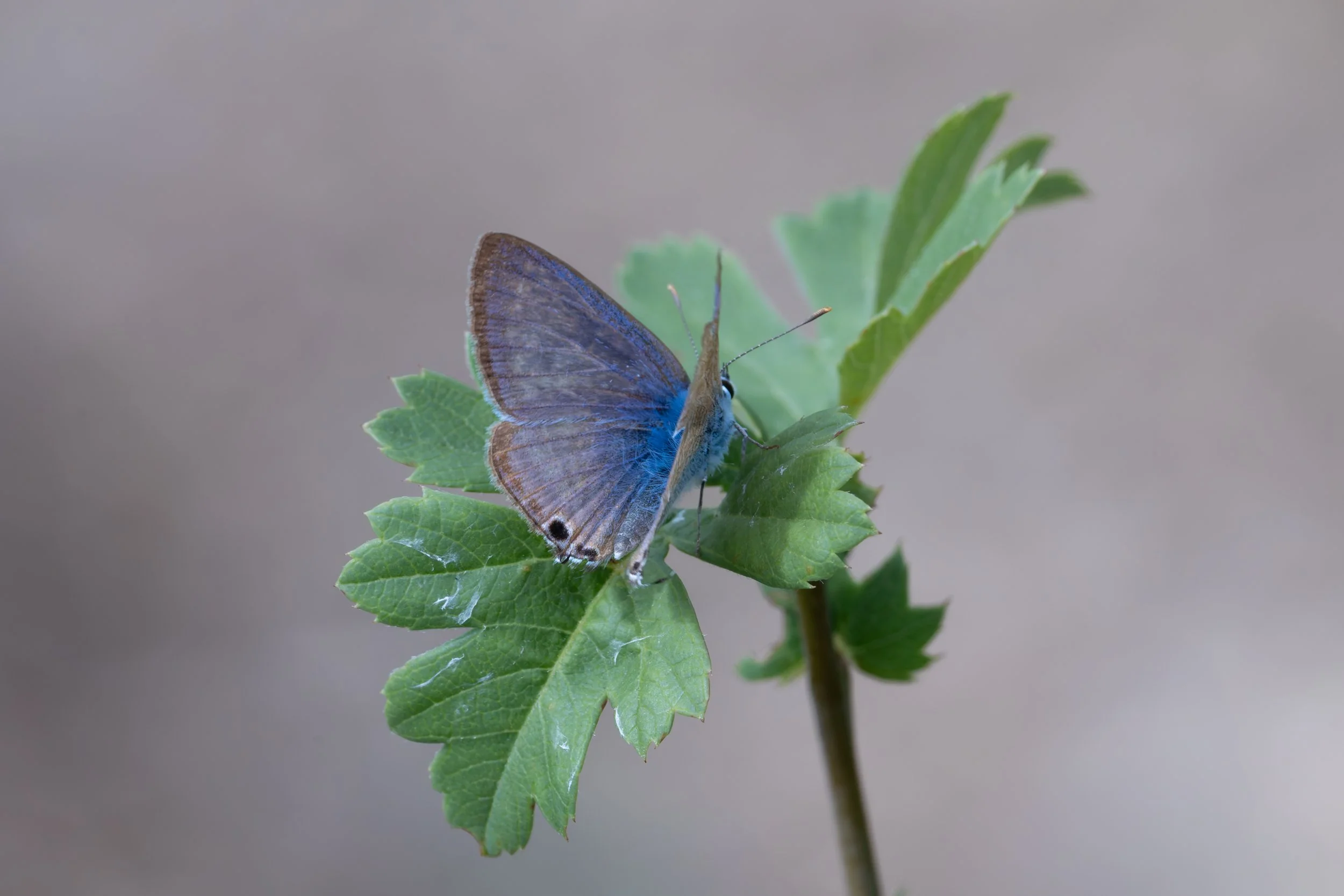
Long-tailed Blue | Lampides boeticus (male) Portsdown Hill, Hampshire (Mike Watson)
Driving south on a Friday evening, we hardly needed the UK Government’s emergency warning alarm to remind us not to start wildfires. The landscape was parched, with every blade of grass turned golden brown. At least we weren’t about to be nuked by the Russians, we thought!
This was nothing new to me. I spent my childhood listening to the occasional test of the four-minute warning siren at the bottom of our street. They didn’t even tell us when it was going to be tested! The huge Vickers tank factory on the Tyne, down in the valley below us, was a major target at the time.
When we reached my mum’s home in Hertfordshire, all the windows were wide open, as were the doors, in an attempt to cool the house after yet another day in the mid-thirties. These well-insulated 1970s homes retain heat like ovens.
Meanwhile, Alexander was enjoying reviewing the security camera footage, which revealed the garden’s nocturnal visitors: two foxes and a badger!
SUFFOLK AND FAMILIAR FACES
My first stop the following day was Walberswick in Suffolk, where I had another go at seeing Zitting Cisticola. This time I was successful. At least three of the eleven birds recently present along the Dingle River were bouncing around in the long grass of the saltmarsh.
Perhaps it was a little like watching the first Collared Doves in Cley in 1952? This common and widespread cisticola looks set to colonise the UK from its current foothold on the Suffolk coast, having bred there for the first time in 2025.
My views of the cisticolas were distant and, on this occasion, it was just another number on a list. I was much happier to bump into an old birding pal from the 1980s, Paul Oldfield, and his partner Tina.
Almost 40 years ago, Paul, Tina and I did a crazy road trip to Fontainebleau, near Paris. In fact Tina did all the driving as she rightly reminded us, 1700 miles of it. It involved, among other things, Tina’s car being broken into and my passport being stolen. Needless to say, I never left my passport in a car again! Turning up back in the UK with no personal details and a broken car window was difficult to explain, and no wonder the customs officials proceeded to take her car apart.
It was nice to be reminded that these days, friendship means more than ticking off yet another bird species.
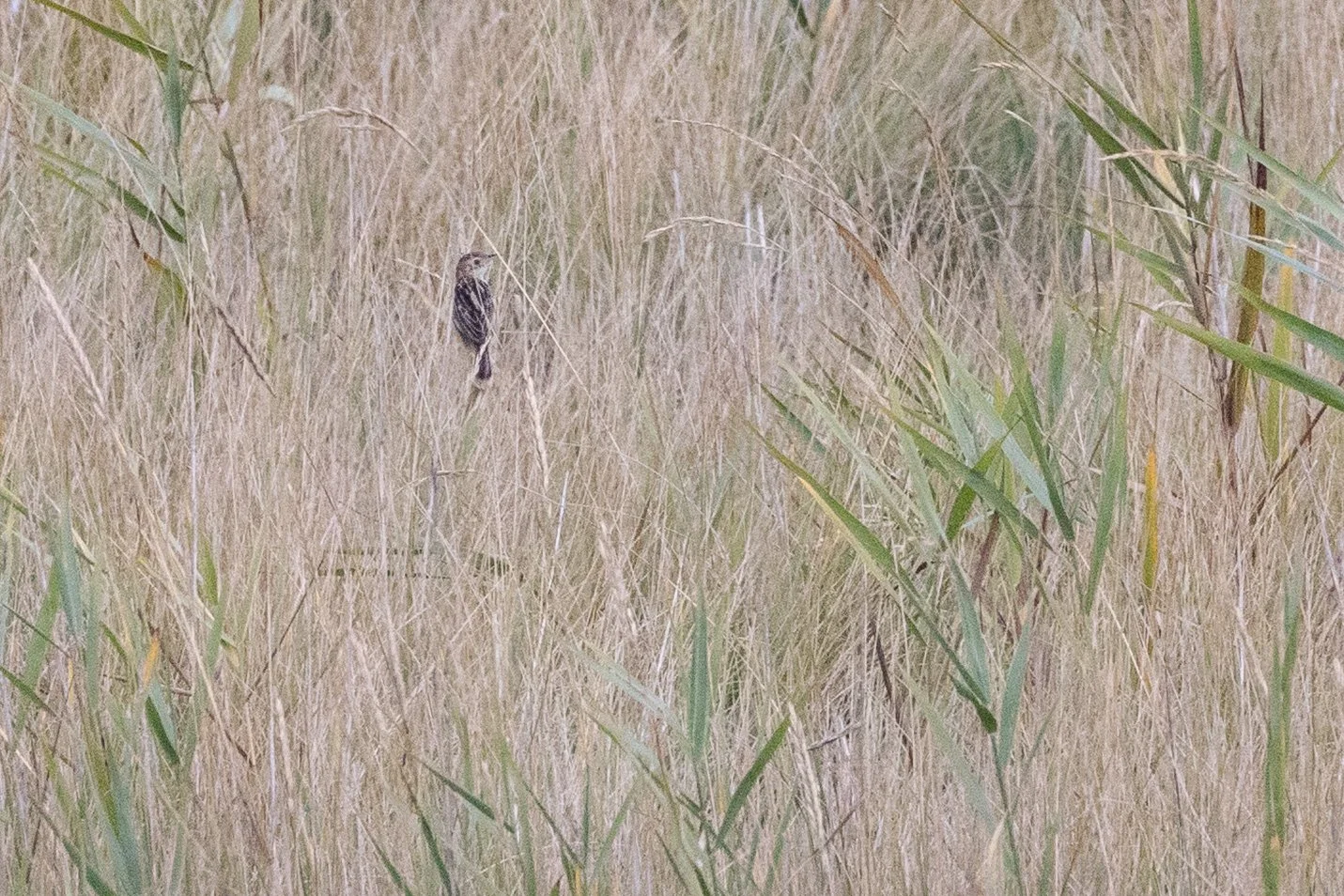
Zitting Cisticola, Walberswick - just another number on a list (Mike Watson)
Suffolk coast south of Walberswick, with Dunwich Coastguards and Sizewell B in the distance (Mike Watson)
39 years later with Tina and Paul
There was plenty of shorebird movement, too, with a couple of Whimbrel, a Greenshank, three Turnstones, four Golden Plovers and several Black-tailed Godwits of note. A pair of Sandwich Terns was on the main lagoon and a couple of Marsh Harriers drifted over the reedbed, while families of Bearded Reedlings pinged out of the Phragmites on a muggy, overcast summer’s day.
The area’s famous windmill has long since fallen into disrepair, while in the distance we could see the tragic, charred landscape of Dunwich Heath. I first saw this windmill in Ian Wallace’s 1979 classic ‘Discover Birds’, it hasn’t changed much. Coincidentally, he also talks about visiting on a muggy day in August and not seeing much.
Walberswick windmill (Mike Watson)
Walberswick windmill - 47 years ago
BUTTERFLIES MOVING NORTH
Back inland in Hertfordshire, I stopped at one of my old regular butterfly haunts, Royston Heath. I was delighted to find plenty of Adonis Blues flying. Their vivid turquoise wings lit up the tinder-dry grassland. The heath is better known as one of THE classic sites for Chalkhill Blue | Polyommatus coridon, particularly for its proliferation of aberrations so prized by the early butterfly collectors.
Adonis Blue was reintroduced to Therfield in 2019, having died out exactly 60 years previously. They have flourished. It is a very welcome unofficial introduction, and this was the first time I had seen the species north of London.
Like the cisticolas, a host of southern insect species are now appearing naturally in the UK with much greater regularity.
Adonis Blue | Polyommatus belargus (male) Therfield Heath (Mike Watson)
Adonis Blue | Polyommatus belargus (male) Therfield Heath (Mike Watson)
Therfield Heath, Royston (Mike Watson)
One of these is the Long-tailed Blue butterfly | Lampides boeticus). On another parched hillside, this time overlooking the naval town of Portsmouth, Portsdown Hill has hosted several of these dainty migrant butterflies over the last couple of weeks.
They behave more like hairstreaks than the downland blues I am used to seeing. The males hold territories and actively defend them from intruders, including Small Whites, Meadow Browns and, of course, other Long-tailed Blues. For such a cluster to be at one site they must surely have bred here this spring?
I enjoyed some fabulous close views, mostly among gone-to-seed marjoram, but also in tiny hawthorn saplings. Having been butterflying since the 1980s, this was a particularly special and long-overdue moment.
Long-tailed Blue has traditionally struggled with northern European winters, much as Clouded Yellow has remained largely a migrant rather than establishing itself. But as the climate changes, both species are becoming increasingly commoner and more regular visitors.
Just a few more signs that our wildlife is changing — with southern species steadily moving north.
Long-tailed Blue | Lampides boeticus (male) Portsdown Hill, Hampshire (Mike Watson)
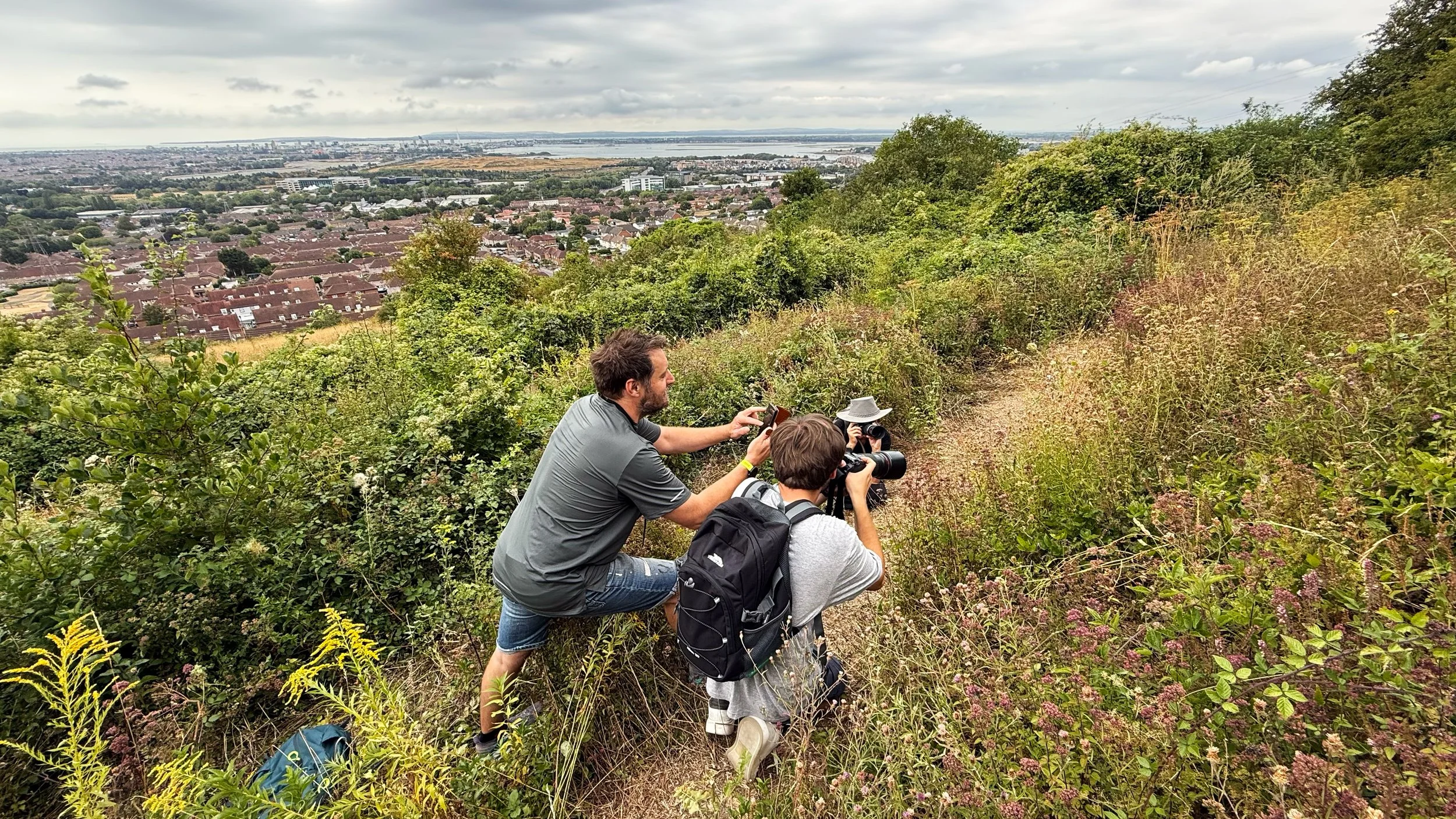
Long-tailed Blue watchers, Portsdown Hill - the loveliest people! (Mike Watson)