Viewing entries in
Birding

Comment

EMPEROR PENGUIN

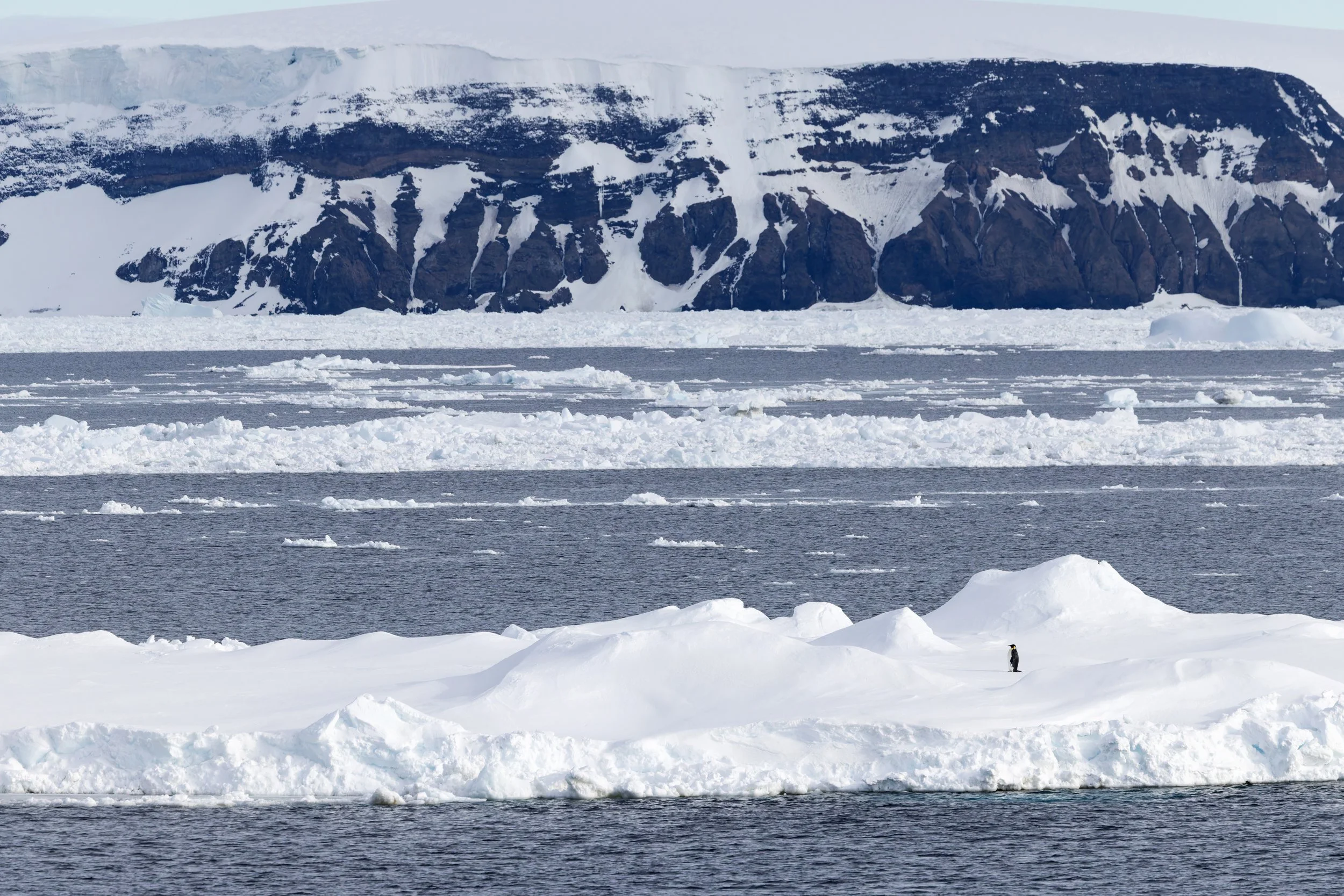
Emperor Penguin, Fridtjof Sound (Mike Watson)

We had spent the night with the bow of MV Ortelius nudged into a large ice flow at the southern end of Fridtjof Sound (on the southern shore of the Antarctic Sound) and we waited for news of the weather and our chance of being able to fly to Snow Hill. There was some low cloud here, so we knew that things weren’t great for our immediate vicinity. Time ticked away as we watched Snow Petrels, Adelie and Gentoo Penguins as well as South Polar Skuas around the boat. Then BOOM! Emperor Penguin on the ice by the boat, spotted by AEL George Kennedy, thanks mate! Panic stations as folks made their way onto deck. It stood only a few metres off the bow, calling to some long-lost pal before it part waddled/part tobogganed to the water’s edge and gracefully slipped into the dark depths. It reappeared briefly but dived and was lost to sight. It must have swum far this time as we did not relocate it. I wonder if its disappearance had something to do with the pod of Orcas that was called soon afterwards? It would be able to hear them from a great distance! Everyone could now enjoy the Orcas too, as they cruised the large expanse of ice-free water behind us. They belonged to Type B – the Antarctic Peninsula form with a huge white oval mark on the side of the head. Shame we could not see their golden saddles though. The pod of around 10 included a calf or two and a couple of large males. Wow that was something, Antarctica in a nutshell! But OMG! David was still in the shower unfortunately and the Emperor had gone by the time he got dressed. Lucky for him it resurfaced sometime later about 100m away and stood on the ice with some Adelies and giant petrels. Phew!

Emperor Penguin, Fridtjof Sound (Mike Watson)

Type B Orcas, Fridtjof Sound (Mike Watson)

This afternoon saw us doing some non-birding activities. Scenic helicopter rides started and the saloon transformed into a departure lounge, minus duty free and soon most people were whizzing off to take a closer look at icebergs etc. The galley crew were also busy setting up the evening’s barbecue, a lovely tradition of these cruises! A quiet afternoon then? No. BOOM! Emperor Penguin off the port side. This one was even better than the previous day’s. Joking that it has been kidnapped on the Snow Hill recce, instead it must have spotted us from afar and made its way to check us out. They are inquisitive like that. This one was also braying and jumping on and off small ice floes, with some great angles and close-range images possible from through the scuppers on the fore deck! Another genuine WOW moment. Interesting to note that it appeared while my heli-ride slot was taking place, funny that! There was a ready-made celebration in the form of the excellent barbecue on the deck behind the bridge this evening. It will be hard to forget Tom Jones blasting ‘Sex bomb, sex bomb, you’re my sex bomb’ through the big speakers, with the Emperor Penguin in the distance. Truly surreal.

Emperor Penguin, Antarctic Sound (Mike Watson)

Emperor Penguin, Antarctic Sound (Mike Watson)

Emperor Penguin, Antarctic Sound (Mike Watson)

Emperor Penguin, Antarctic Sound (Mike Watson)

Emperor Penguin, Antarctic Sound (Mike Watson)

Emperor Penguin, Antarctic Sound (Mike Watson)

Emperor Penguin, Antarctic Sound (Mike Watson)

Comment

Comment

ANTARCTIC PETREL

Antarctic Petrel, 70NM north of South Shetland Islands (Mike Watson)

ANTARCTIC PETREL! I was lucky to be able to shout this a few times on my recent Birdquest, Antarctica: In Search of the Emperor Penguin tour. There’s more to it though. Last time I was down there I only saw one of these ‘Ice Petrels’. It is one of a trio of birds that you really need to go to Antarctica for, along with Emperor and Adelie Penguins. Snow Petrel occurs in South Georgia, South Polar Skua can be seen in the northern hemisphere and the Antarctic form of Imperial Shag is currently lumped. That’s it. Early one morning I was making my usual pre-birding visit to the hot chocolate machine in the saloon of MV Plancius when one flew past the window. In a panic I raced around the ship trying to get the message to the other folks on the tour, failing miserably and by the time I had gone through all the motions of that it was flying away from the ship, into the distance, not to be seen again. That was it, no photo, just a few views through spray-covered windows. Although I had just seen a terrific bird I felt deflated, a crazy outcome of what should have been an exciting experience. My pals said I was wrong to have attempted to get anyone else, birds often come and go quickly and if you want to see it then you ought to be on deck looking. I’ve come around to this way of thinking and it really is the only practical solution. If something significant turns up and sticks for a while then the expedition team can use the communications system to announce it.

Antarctic Petrel no.#1 in a force 10 snow storm wasn’t easy to see, it didn’t stay for long and while it did, viewing conditions were poor

After our first brief sighting, north of the South Shetland Islands (but south of the convergence), which was only seen by a couple of us, we had to wait for a few days until the next, which was in glorious sunshine in the Bransfield Strait and circled the boat for at least five minutes, allowing everyone to get up on deck and see it thanks to the tannoy. It was high-flying and often above eye-level, with two Pintado Petrels and after some time their circling became quicker and the trio gained height before zooming away somewhere.

Antarctic Petrel Sighting no. #2 is much more obliging complete with evening sunshine and blue sky!

We were all quite happy to see this one, but some folks arrived too late to get a look at its upperside. So, the pair of them that followed the boat for almost TWELVE HOURS (!!!) on our northward journey in the Drake Passage was very welcome indeed. We could take a rest, have something to eat etc and go out on deck and there they were, still zooming around the boat, in better light in the afternoon and with a gang of other excellent seabirds. A quite incredible encounter, after which we couldn’t wish for better. They were so close at times you could almost reach out and touch them as they sped past deck six! I even saw them from my cabin porthole. Alain had three together late in the afternoon, before all of the seabirds veered away, more or less at the convergence. What a great experience that was, even better than the penguins for me!

Antarctic Petrels nos. #3 & #4 were even better, almost twelve hours of buy one get one free!

The Antarctic Petrels occasionally dropped lower to water level, allowing some great looks at the upperparts

Antarctic Petrel is a powerfully built seabird, hardly surprising considering where it lives

Antarctic Petrel - Ian Lewington painting effect?

Antarctic Petrel through the wake

Following the leader, Black-browed Albatross, with an Antarctic Prion in tow

Pintado (or Cape) Petrel for comparison, I love the description in Howell’ & Zufelt’s excellent Oceanic Birds book that ‘Antarctic Petrel looks like a Pintado Petrel that has been organised’.

Snow Petrel - we were treated to so many great looks at the other ‘Ice Petrel’.

Comment

Comment

WHITE-BELLIED SEEDSNIPE IN ARGENTINA

White-bellied Seedsnipe, Rio Valdez (Mike Watson)

BY NOVEMBER WHITE-BELLIED SEEDSNIPE HAS RETURNED TO ITS ALPINE ANDEAN BREEDING GROUNDS. THE classic site for it is Garibaldi Pass, on Ruta 3 north of Ushuaia, in Argentina’s far south. Crikey, as we crossed the pass, I was delighted that Birding Ushuaia had recently pioneered access to a much more accessible site for it, seeing its habitat above the endless Southern Beech treeline now covered in deep snow, in fact it was still snowing. After my encounter in Chile in September, I was keen to catch up with it on its breeding grounds but instead of enjoying watching it at leisure, it was clearly going to be a challenge to reach the required altitude in this weather let alone be able to locate one in the snow. ‘Do they stay up high in bad weather?’ was a hopeful question. ‘Yes’, the disappointing answer from our guide Federico. The new site in the Rio Valdez reserve is on the nothern side of the Andean watershed and does not bear the same brunt of weather coming from the south as Garibaldi Pass. The weather was still poor, the mountains above Ushuaia had a fresh covering of snow and we had already seen some evidence that things were rough up high today in the form of a mini fall of Dark-faced Ground Tyrants near our hotel on the edge of town. This was the tail-end of a large storm that had killed hikers in Torres del Paine some days earlier, no wonder I couldn’t see it through the mass of cloud my flight had entered after leaving El Calafate. Other gems driven downslope by the snowfall were a flock of Austral Parakeets feeding on dandelions in town (!!!) and the high-altitude loving Ochre-naped Ground Tyrant that we saw on the gravel airstrip at Lago Escondido en route to the the north side.

Austral Parakeet, Ushuaia (Mike Watson)

Ochre-naped Ground Tyrant, Lago Escondido (Mike Watson)

Eventually we made our way up through the beechwoods on the north side of the mountains, timber is harvested here and there are forestry roads, complete with padlocked gates(!), it would be difficult to reach the highlands above the forest without a guide with keys, even armed with waypoints. The trailhead at the end of the rutted forest track lies only a gentle 4km uphill stroll from the seedsnipe habitat, much easier than the 45 degree Garibaldi Pass slopes and more akin to a walk up Longridge Fell at home. However, it was a drag today in the snow, significantly trickier than usual and where it did not lie in the forest the track was waterlogged. It would normally be very enjoyable through the lovely, pristine, moss-covered beech trees. We left the trees behind and crossed an area of longer grassland before a snowy hillside. Yellow-bridled Finch and Rufous-chested Dotterel, two specialities of this spot, appear in quick succession. The males of both these extraordinarily beautiful birds lit up the white landscape and afforded stunningly close views. Ochre-naped Ground Tyrants had also stayed up here, at a slightly lower elevation than the pass. We paused for a cup of coffee, as Federico guided us to a likely spot for the seedsnipe, which he keeps regular tabs on, and indeed, one is there, sheltering in a snow-free streambed. So nice to see it on its alpine breeding grounds! But the snow is already melting now, swirls of mist evaporate from the lichen-covered hillside as it is time to leave, quite a different scene to our arrival here!

Yellow-bridled Finch, Rio Valdez (Mike Watson)

Rufous-chested Dotterel, Rio Valdez (Mike Watson)

White-bellied Seedsnipe, Rio Valdez (Mike Watson)

White-bellied Seedsnipe, Rio Valdez (Mike Watson)

Rio Valdez scenes (Mike Watson)

White-bellied Seedsnipe country, Rio Valdez (Mike Watson)

Comment

Comment

WHITE-THROATED NEEDLETAIL

White-throated Needletail, Scarborough Castle, 10 October 2025 - consecutive frame collage (Mike Watson)

WHITE-THROATED NEEDLETAIL! That’s a name to get a birder’s attention. Sitting at my desk in the Birdquest office, the Birdguides app notification certainly grabbed mine. It had already gone from Tophill Low Reservoir though, so I put it out of my mind. Later, almost at the end of the day… Yikes, it was now at Bempton Cliffs and within a few more minutes it was hanging around! A spam of messages followed as local birders caught up with it, but it was too late to set off from East Lancs for a bird in East Yorkshire. Can you imagine the traffic with lots of tractors on the road at this time of year, plus max. HGV numbers, even if there was just enough time? A couple of things. It had been relocated at Bempton by an Oriole Bird Tours group! There were 2000+(!) photos taken of it at Tophill Low by people who thought it was a Merlin… and then an Alpine Swift! The general lack of knowledge these days is shocking. I have a theory that this has something to do with a reliance on apps that are only dipped into when we need to, instead of books, which we used to read from cover to cover and learn about things we had not yet seen. Or maybe there is just a lack of interest in nature other than as a photographic subject? The last message of the sequence, at 20.46 included ‘earlier seen attempting to alight on cliffs’. That was all that was needed for hundreds of hardcore twitchers to be stood on the clifftop at Staple Newk (the Black-browed Albatross spot) before dawn the following morning. Familiar faces! Alan Lewis, Trevor Ellery, Sam Viles, Ash Howe, Paul Chapman, Richard Bonser, John Hague, Johnny Mac, Lee Evans, Richard Fairbank and even my doctor Steve! Plus an endless series of faces I recognised as older versions of how I remembered them. There was talk of an early possible sighting in the thermal cameras, but this got squashed at the time, attention turned to a lovely sunrise over the sea and I was starting to imagine a swift hawking over the cliffs in the morning sunshine. That was until 09:14. ‘White-throated Needletail, Loch of Skene, Aberdeenshire, one over north-west side briefly’ WHAT? The message said ‘also 4 Ring-necked Ducks’… no-one cared if there had been 400. There was some nervous laughter and then the exodus started. Seven and a half hours/366km away! One car, Andy Clifton’s, even made it all the way there, and that was after a message at 11:10 said ‘still no further sign by 10:57’. I wouldn’t contemplate driving so far for it and I find it difficult to believe that it could be the same bird. Do they migrate at night? Apparently, yes. Time ticked away with no further updates, so I went to work. Maybe that was that?

Again, towards the end of the afternoon, I was moaning to a guest about what I’d been up to that morning when another Birdguides notification appeared ‘White-throated Needletailjuvenile at Filey Brigg’. A lot of swearing and another series of updates followed. Much as this annoyed me, I hoped at least Paul Chapman had seen it. He had endured the most painful series of dips on this one, including the Harris bird being killed by a wind turbine while he was en route. Thankfully he did see it at Filey! He had said how he had already committed to staying in the area, just in case. Next level twitching experience. I had to talk to Bolton RSPB group this evening and managed to get through this without too many yawns and then it was off to bed with another very early start. Only this time I was more optimistic about it being seen the following day. That’s two days in the same general area now. Surely it must just have moved up the coast a little beyond the scope of the birders searching around Bempton? Maybe it fed high in the sky and evaded detection? I can’t imagine that a swift would fly non-stop to northeast Scotland and then turn around immediately and fly straight back to the same stretch of coastline 366km away? Either way, I was back next morning, on Filey seafront this time. Familiar faces again. Paul Chapman was back for more, Archie and the Peaky Birders crew, Sam Viles, Ash Howe, John Regan, Lee was here again (but downbeat about our chances as always), Ian Smith and Trevor Ellery, my Birdquest colleague. Again, it was a sunny morning and looked perfect for a swift to be feeding along the seafront, but again time ticked away without a sighting. A bacon and egg butty was just about to become the highlight of the day, when the hoped-for message came through. Shouts of ‘It’s at Scarborough’ could be heard along the promenade and birders ran to their cars. I didn’t have any experience of daytime traffic in Scarborough. Note to self – it’s awful. What a ridiculous system, so progress from Filey was quite slow until I turned right to a parallel road along the sea front, which had no traffic and then I approached the castle from the northwest, that worked well. Something worth bearing in mind for another day.

White-throated Needletail, Scarborough Castle, 10 October 2025 (Mike Watson)

White-throated Needletail, Scarborough Castle, 10 October 2025 (Mike Watson)

I first set eyes on the needletail over the Sycamore trees from the castle’s barbican, however, the best vantage point is the viewing platform on the inner bailey wall, overlooking the harbour and town, as well as the north bay. Racing up there, it was very nice of the English Heritage staff to give birders a concessionary rate to enter the castle, thanks! The needletail was very mobile indeed, hawking for insects and feeding very widely over the south bay and the castle woods, covering a hundred metres or more in a few seconds. Viewing conditions could have been better as most of the time watchers on the castle were looking into the sun but a couple of times it zoomed low over the small crowd of us on the ramparts. What a setting! The wall we stood on was built between 1198-1206! It even landed very briefly or rather bounced off the wall of the great tower itself. As far as my favourite rarity events go, it is up there with the Doctor’s Garden White-throated Robin, Spurn Siberian Accentor, Anglesey Black Lark, Vorran Island Steller’s Eider and the Salthouse Little Whimbrel. All birds I never imagined I would see in the UK when I was a kid, visiting Scarborough on our summer holidays. What a grand day this one was.

Needletail watchers Scarborough Castle (Mike Watson)

There have been 10 previous British records of White-throated Needletail, one of which was 120km offshore from Caithness, on the cruise ship MV Ortelius. The first two were shot in the 1800s and five were on outer islands, leaving only two mainland records. I missed the first of these, at Fairburn Ings forty years ago, on 27 May 1985 (we raced there from North Norfolk and spent the rest of the afternoon chatting to birders from all over the country but the swift had departed ahead of rain). None of these were in autumn, or juveniles, which makes this one very special. Add to this the fact that the extreme western end of this Asian swift’s normal range, in the western Himalaya, is 5,000 miles away. Most of them spend the winter in eastern Australia!

It would take 70 days to walk to the nearest hotspot from the UK (Google Maps thinks you could walk 68 miles per day!)

The name Scarborough was long thought to have derived from the Norse ‘Skarði's borg’, meaning ‘Scarthi’s Castle’, however, this has been questioned recently - there has been a stronghold on the site of the castle for 3,000 years. The royal castle itself has a long and interesting history. Building of the main fortifications, including the great tower, began in 1159 during the reign of Henry II and it later hosted several subsequent monarchs: King John, Edward I and Richard III. Mel told me that in the English Civil War, a single Parliamentarian cannonball weighing 25kg had split the wall of the great tower during the siege of 1645! It was fired from St Mary’s Church below the castle, where most of the birders parked today.

Recipient’s view of a cannonball fired from St Mary’s Church! (Mike Watson)

Comment