Comment

BLACK ROSY-FINCH

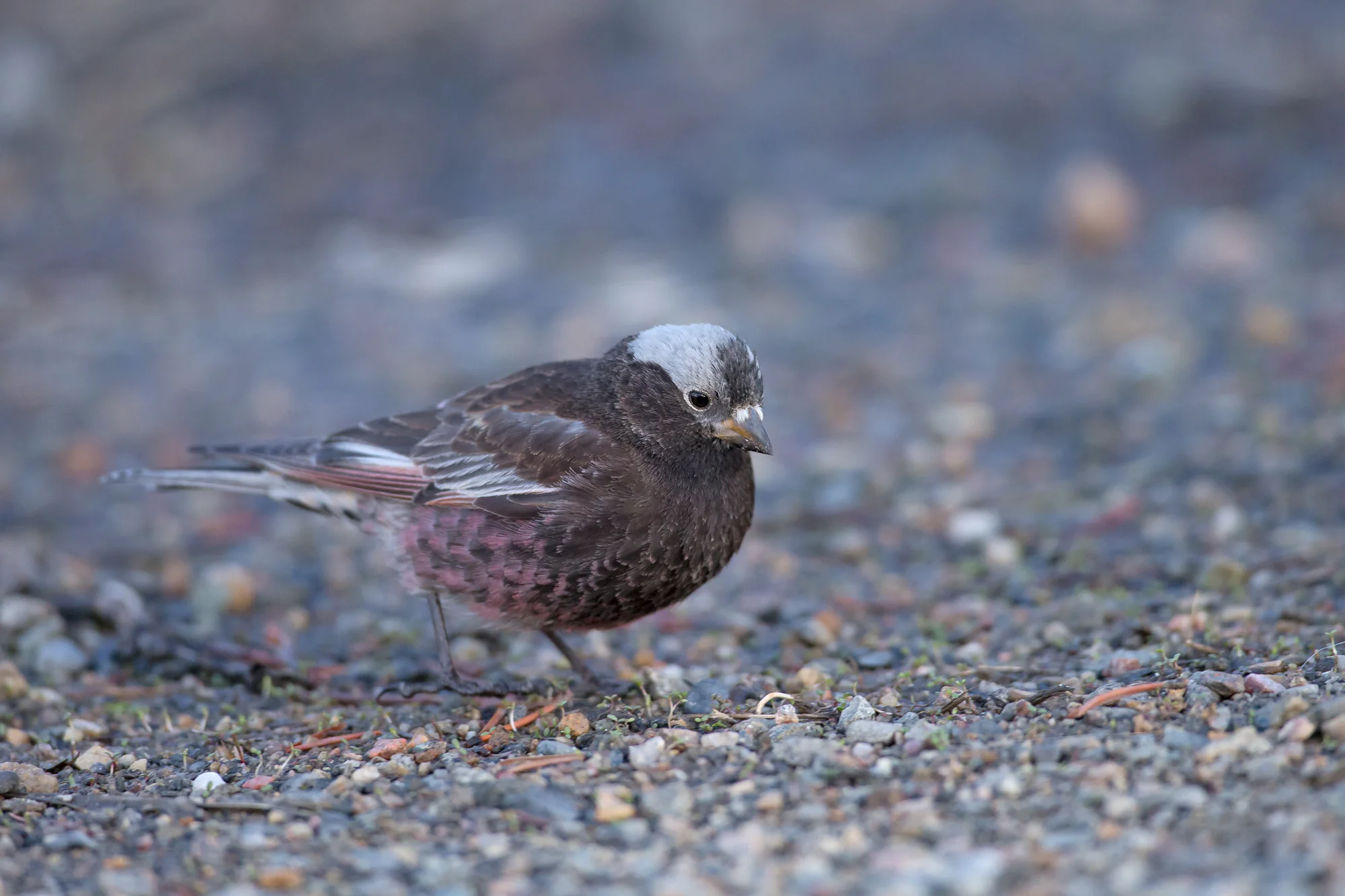
Black Rosy-Finch, Silverthorne, Colorado

Black Rosy-Finch, Silverthorne, Colorado

BLACK ROSY-FINCH IS THE STAR non-grouse on the Colorado spring chicken run. I am so lucky with this bird, never to have missed it but I haven't seen it in the same place twice on each tour and it is emminently missable! With a restricted breeding range it is a true USA endemic - it isn't even on any other country's list as a vagrant! They are almost always in the minority of rosy-finch flocks in Colorado as well, which sometimes makes finding then a challenge, when the finches are resting in pine trees for instance. However, once around a feeding station they do not pass in a crowd and are the smartest of the quartet of North American rosy-finch forms in my opinion. I'm hoping that my present lucky streak holds out for them.

Comment

Comment

DUSKY GROUSE

Dusky Grouse, Black Canyon of the Gunnison.

DUSKY GROUSE IS ONE OF COLORADO’S MAGNIFICENT SEVEN grouse species (there is an eighth, Ruffed Grouse, but this one is a little too remote in Dinosaur National Monument to be included in the spring grouse circuit). It was great to spend some time hanging out at one of my favourite birding sites of all before the tour – The Black Canyon of the Gunnison. Pete and I had some great encounters, including a male that sat up perfectly on an exposed, lichen-covered rock, the early morning sun catching its plumage with a dark background. I could hardly have composed a nicer setting in my mind’s eye. Apart from its Dusky Grouse, the Black Canyon is a great place to bird at the same time as admiring its jaw-dropping scenery. There are few places in the world like it.

Pete Loncar enjoys breakfast overlooking the Painted Wall.

Comment

Comment

WHITE-TAILED PTARMIGAN

White-tailed Ptarmigan - a vision of blue-and-white in the first rays of early morning sun.

WHITE-TAILED PTARMIGAN IS ONE OF MY FAVOURITE BIRDS and I have been lucky to have many great encounters with these beautiful high altitude grouse in Colorado's Rocky Mountains. Snowshoes tightened in the dark, I set off with my friend Pete Loncar on a long hike, intended to reach the ptarmigans just as the first morning rays of sun hit the snowy slopes where they spend the winter. On the way up we could see the tracks of Snowshoe Hares on the sides of the trail and eventually we were thrilled to see some of their makers as well, in their white winter coats. They were very timid and it was still quite dark before dawn. I am hoping that one day we will see something much bigger on this hike! We were lucky to have timed our arrival perfectly and as we arrived in the place to be, the sun was just popping over the mountain ridges to the east of us, lighting up the ptarmigans perfectly. We were careful not to disturb them too much even though they allowed very close approach, life is hard enough up here at 4000m ASL and we could watch them feeding on small willow buds, moving from one clump of bushes to another. In total 39 birds were scattered across a fairly small area, some taking shelter next to the tiny pine trees dotted amongst the willow bushes. This year marked the 25th anniversary of the first time I saw White-tailed Ptarmigans here, where did all the time go?

Comment

Comment

SIGNS OF SPRING IN RIBCHESTER

A line of old oak trees in the Ribble Valley near Ribchester.

A WALK AROUND RIBCHESTER on a lovely spring day produced 49 species of birds, which is not bad for an area lacking an obvious birding site. The highlight was a flock of 15 Whooper Swans heading northwest over farmland to the north of the village, towards Longridge, calling. However, an ill-timed light aircraft caused them to veer southwest and out of sight. I also managed a new bird for the village today, Tufted Duck - a pair on a tiny decoy pond not far from High Alston Farm. Curlews, Lapwings and Oystercatchers are back on their breeding grounds and there were a couple of pairs of Common Redshank along the river. Great Spotted and Green Woodpeckers were noted along with a nuthatch and my first Chiffchaff of the year, singing by the river at Old Park Wood. Over 60 Fieldfares continued and one of their small flocks contained at least seven Redwings, which will also be on their way east again soon. Buzzards were conspicuous with six soaring on the warm thermals and a female sparrowhawk was pursued relentlessly by a crow up high into the sky. Mammals included a roe deer, three grey squirrels and three Brown Hares and a Small Tortoiseshell butterfly was my first this spring. In the afternoon Tree Sparrows were busy at the colony on the edge of the churchyard bringing the total to 50 for the day.

Comment