
Comment

ALSTON OSPREY

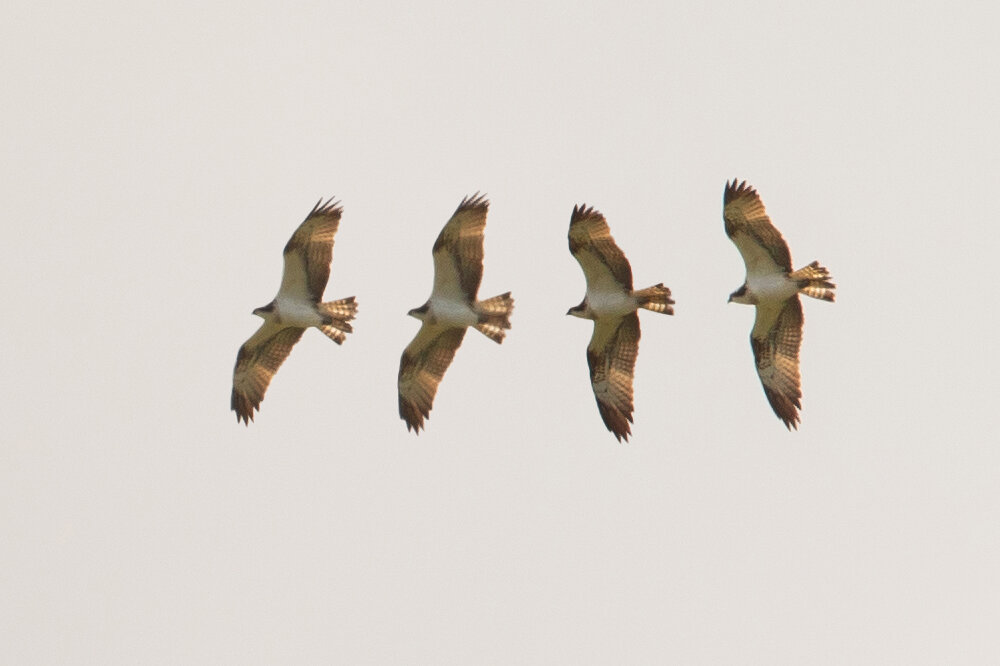
18 April Alston Osprey collage

2021 ELOC OSPREY NO. #3 FOR ME flew over Alston Reservoirs this evening at 1853–1902. It makes a nice change from missing them, which is what I normally do, however, I have made more effort than usual this spring. It was lucky that I turned around and scanned to the south from the central screen when I did, so I picked it up flying in from way to the south. This allowed enough time for Gavin Thomas to scramble and intercept it as it flew from no.#1 reservoir and crossed to no. #2, before pausing to hover briefly and then continue away over the town. I wouldn’t mind a closer osprey this spring but it is always a thrill to see one on migration. Gav tells me they detour to take a look in each reservoir without fail as they fly north over the site. It was getting quite late in the day and we wondered where it might roost this evening.

The rest of the evening’s birding at Alston was fun with highlights the nine whimbrels that flew in to roost with 38 curlews after sunset. A lovely sight and sound although it was all curlew song rather than piping whimbrels. A drake shelduck flew in too and four shovelers were present - more new 2021 5km-from-home-list birds! Other birds on the wetland included a Great Black-backed Gull, nine teal, two Tufted Duck, two snipe and Little Ringed Plovers and three redshanks. Five Goosander was apparently a recent peak count and a flock of 58 Fieldfares was in the trees that line the fields to the south of Pinfold Lane. Spring migration through the ELOC area is always an anjoyable time of year!

Curlews at dusk with a few early whimbrels
Comment

Comment

HARE HIGHLIGHTS

Brown Hare, Ribchester

BROWN HARES ARE VERY CONSPICUOUS AROUND RIBCHESTER at the moment, as the grass in the fields is a little late in growing following the very cold start to the month. It always amazes me how daft they are, sometimes oblivious to me, when I crouch down. Standing up they keep their distance. Birding today included the first Yellow Wagtail for me and Phil in the village. I imagine the meadows in the valley were once full of them but they have not bred in East Lancs since I have been here and that’s over 15 years now. Three very loud single ‘tseeeep’ calls signalled its presence as we saw it fly over us on Shorton Lane and then over the farm towards the river. We spent some time trying to relocate it without any luck but I am not allowed off the footpaths here anymore so that was that.

Other highlights today included three Little Ringed Plovers opposite Churchgates, our highest number so far. There was a lot of song-flghting but one pair of them later flew west over Lower Barn. A redshank was on the field pool above Parsonage Farm where there are some excellent signs asking for dogs to be kept on leads in the field where the lapwings are nesting. There was a pair of skylarks here again today and three Greylag Geese too. A pair of Reed Buntings was on another field pool, a very scarce breeding bird down in the valley and I heard five singing Willow Warblers on my circuit this morning, also my highest count so far. No Common Sandpiper, whitethroat or redstart yet though but they have already reached nearby Alston and Brockholes so any day now but it looks like yesterday’s Fieldfares may have gone.

Reed Bunting, male moulting into breeding plumage - almost there now!

A lovely cloudscape over Ribchester at dawn this morning, forming high heaps of Altocumulus

Comment

Comment

COMMON SCOTER IN RIBCHESTER

Common Scoter (female), near Waterside Farm, Ribchester in a golden sunrise.

THE KEY WORD IS ‘IN’… RIBCHESTER! I said ‘Hi’ to Phil on the riverbank this morning. ‘No luck with otters so far’ and then…’BAM!’.Female Common Scoter’ on the river right next to us off the allotments. I hadn’t really expected we could get one actually on the river here as it isn’t that wide but there it was. No nocmig sound record or infrared-night-time-flyover-dot this one! But instead prolonged views of this terrific sea duck, pausing for some reason at the start of its trans-Pennine migration. Recent studies have shown that they migrate almost exclusively at night from the Irish Sea to the east coast and this one did not get very far. I wonder if it could possibly be the Brockholes bird last reported on the River Ribble there on 27 March? It was well-behaved enough to wait for Kris and Rachel to arrive as well.

We don’t get many interesting duck species on the patch in Ribchester so two in one day was exceptional when a drake Red-breasted Merganser appeared on the river below us at Red Bank. It afforded some great views as it slowly swam upstream towards Boat House. I am guessing that, in view of its genuine rarity in the lower valley area, it was the same bird as on 8 April.

Other interesting sightings today included a Little Ringed Plover song-flighting along the riverbank, one Common Redshank over Lower Alston Farm, a flock of around 30 Fieldfares in oaks north of Red Bank (it is getting late for this winter visitor now!), two singing Eurasian Skylarks (one of which was paired up), several Meadow Pipits, at least four singing Willow Warblers on the same circuit as last Sunday and flyover Linnet and redpoll. All on a glorious sunny spring morning that warmed up nicely after the overnight frost.

So April presses ahead as the best month of the year, now on 85 bird species (all time)/78 (2021) and my Ribchester patch list moves up to 117 (all time)/89 (2021). It’s all good fun!

Red-breasted Merganser (drake), Boat House, Ribchester.

Common Scoter complete with Ribchester riverbank evidence!

The regular Tawny Owl had switched perches today!

Eurasian Skylark still clings on in the farmland around Ribchester.

Comment

Comment

RIBCHESTER OSPREY NO.#2

The second Ribchester osprey in a week! A collage of the 1529 sighting. CLICK IMAGES FOR LIGHTBOX

MORE SKY-GAZING FROM THE BENCHES BY THE SCHOOL PRODUCED ANOTHER OSPREY TODAY. At 1450 I noticed a group of Black-headed Gulls form a very tight flock as they flew upstream, calling noisily, looked up into the sky and bingo! Another Osprey! However, on a day of fluffy cotton wool clouds and huge updrafts this one was very high in the clouds. I fired off a few record shots and called Phil but it was quickly lost in the whiteness. Staring at the sky for almost another 40 minutes and nothing until 1529. BAM! There it was again, this time flying downstream from the benches, pausing for a while to hover over the river just down from Lower Alston Farm. Checking photos later it appears to be the same bird (as you would expect). It has a couple of distinctive notches in the trailing edge of the left wing and it has quite a ragged tail. The wing pattern looks a little different in the photos but the first set, when the bird was further away, is so much poorer resolution and the detail is insufficient to compare the barring etc. It was another adult, like the bird on Thursday.

The morning walk produced a respectable total of 58 species and highlights were no fewer than three skylarks, two of them singing, one over the meadow on the opposite side of the river to Boat House and the other singing overhead at Red Bank. These could have been the same bird of course but it was chasing with another Red Bank so there were definitely at least two. A rare bird down in the valley nowadays. A Jay was at Red Bank and three kingfisher sightings included a pair downstream from Boat House. A Redpoll and three Reed Buntings were at Red Bank and the pair of Little Ringed Plovers was still along the riverside. Spring migrants included two singing Willow Warblers, two chiffhcaffs and five Blackcaps. Mammals were quite in evidence on another glorious sunny spring day with nine hares, a rabbit, two Roe Deer and an otter.

A zoomed-in collage of the 1450 Osprey sighting.

A zoomed-in collage of the 1450 Osprey sighting.

Common Gull (second calendar year). They become very infrequent around Rib by mid April..

One of Ribchester’s terrific old willow trees.

A rather precariously over-hanging willow. It’s days are numbered sadly so enjoy it while you can.

Comment