Comment

Manchester, so much to answer for...

Bonxie at Audenshaw Reservoirs 

Mark Varley and I met at the Scottish Restaurant on the A59, discovering that Rocket was confined to his nest after a night on’t ale in Accy and Alan McBride had ended up in a pub somewhere in Preston. The previous day I had some time with the Great Skua at Audenshaw Reservoirs and managed a handful of frames while it dodged the RSPCA man with a net trying to catch it. On Saturday it had been zooming all over the reservoirs at full speed, harassing gulls but today it looked very sluggish and unwell. Great Skuas are rare inland in the northwest and I am still waiting for one in East Lancs but it was sad to see it looking ill today. As if the skua was not enough, a nice local birder asked ‘is it confirmed?’. It was - a juvenile Red-necked Grebe was not something we expected today but I heard later one was reported from here a couple of weeks ago. It is another local rarity so surely the same bird. Further north behind Bob's Smithy Inn, near Winter Hill, the four Glossy Ibises were still present digging up earthworms in the rough pasture and occasionally coming to within five metres range, their iridescent plumage shining in the afternoon sun. We even had time for a pint afterwards and all this without being shot at. Although it has produced some of my favourite artists like Morrissey and Buzzcocks I don't much like Manchester. CLICK ON THE IMAGES BELOW to scroll..

Comment

ANOTHER WINDY AUTUMN DAY ON PENDLE HILL

Comment

ANOTHER WINDY AUTUMN DAY ON PENDLE HILL

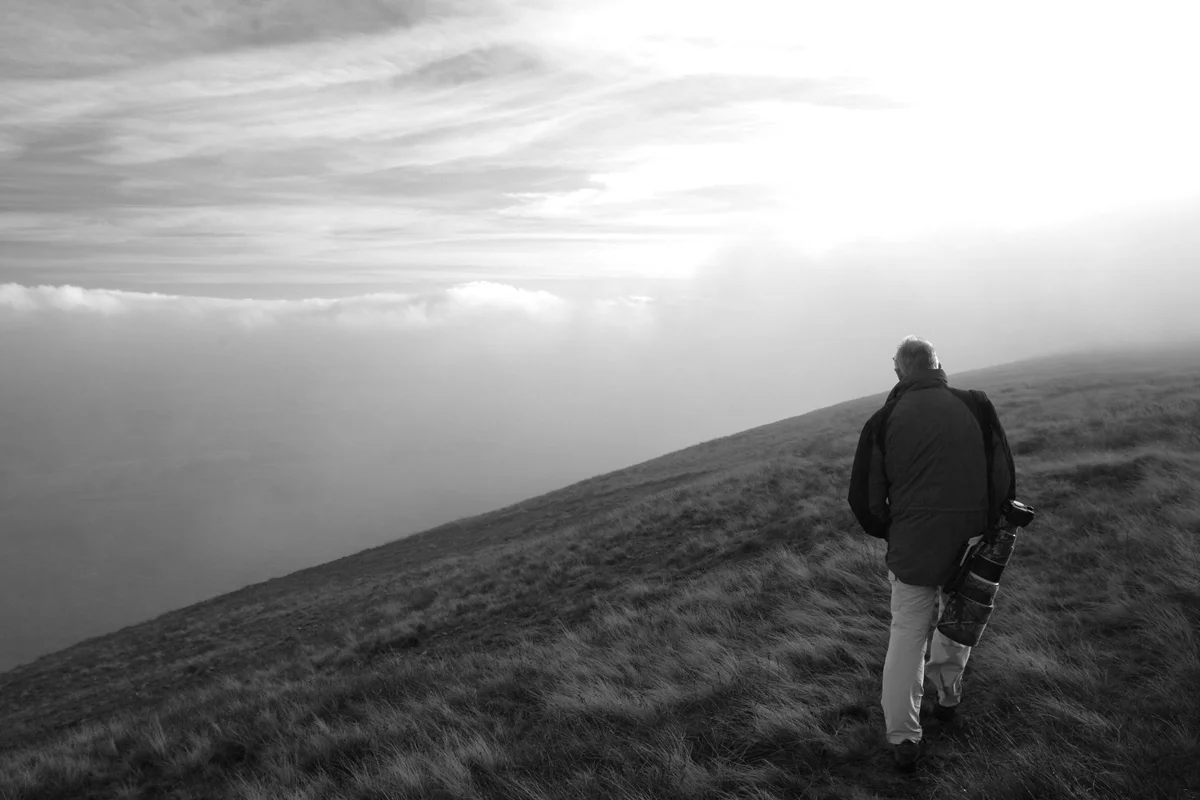
Alan makes his way along the Downham slope, the site of last autumn's Lapland Bunting 

PENDLE HILL usually promises so much but generally delivers very little except for a good workout, especially in autumn. However, it does get good birds from time to time and that possibility is what attracted me and Alan McBride today. Ultimately three Northern Wheatears and a single Common Snipe were the only rewards for our efforts but watching the sunrise and the views of the Ribble Valley were magnificent... between the gaps in the low mist clouds that were rolling across the summit. We saw around 7 or 8 Red Grouse, 2 Common Kestrels, a couple of Eurasian Skylarks and several Meadow Pipits but as usual fell short of 10 species on the hill itself. We agreed that at least the walk counteracted our pre-dawn visit to the Scottish restaurant on the A59.


Comment

MIDWEST BIRDING SYMPOSIUM

Comment

MIDWEST BIRDING SYMPOSIUM

American Herring Gull against an Erie sunrise at Lakeside OH

DESCRIBED AS THE ‘WORLD’S FRIENDLIEST BIRDING EVENT’, the 2013 MidWest Birding Symposium held at Lakeside Ohio certainly lived up to its billing. Although I was mostly chained to the Birdquest and Wild Images booth and couldn’t take part in many of the numerous events I still got to meet a lot of enthusiastic attendees that also included friends from the US festival circuit as well as some of Ohio’s keenest birders. There was a real buzz around the quaint little former Methodist community of Lakeside as it was taken over by the birders for the event. Gail, a lady staying at the same place as me was so impressed by Alvaro Jaramillo’s talk about gull identification she was busily trying to track him down to book on one of his tours. Anyone who can stimulate such interest in the usually low-key topic of gull id deserves a medal the size of a bin lid! The hotel receptionist, a non-birder, was looking forward to Jen Brumfield’s Lake Eerie pelagics presentation. Even the warblers couldn’t keep away with an amazing circa 15 species seen in the trees around the vendor area at the South Auditorium following a perfectly-timed mini fall out of migrants along the Marblehead Peninsula. A big thank you to Bill Thompson III and his amazing team for making it all happen!

Blackpoll Warbler, Magee Marsh boardwalk (Mike Watson) 

 I spent my free time at one of my favourite birding hangouts just along the lakeshore to the west – the World famous Magee Marsh boardwalk, where I was very happy to wander slowly over the boards in search of warblers to point my camera lens at. Catbirds scolded from the shadows and from time to time small feeding flocks of migrant wood warblers would pass by, calling as they went.  This was in contrast to their spring behavior when they often seem to stick to a small, almost territorial area of the damp woodland, feeding up before they push on northwards. They were mostly Blackpoll Warblers, feasting on invertebrates amongst the leaves, or stuffing their faces with little dogwood berries but there was also the occasional flash of lime green of a Chestnut-sided or a black-and-white ‘mint humbug’ and I managed a quite respectable 17 species over the course of my stay. First prize went to an ultra smart Golden-winged Warbler that hung around long enough for a few other folks to get some looks at it and a Brown Creeper and one of the first Winter Wrens of the autumn were also of interest to me at least. Any time spent with these precious wood warblers is special for me when I think how far we are prepared to travel for a single one of them back on my own side of the pond! 

Black-and-white Warbler, Magee Marsh (Mike Watson) 

Comment

Comment

THE KILNSEA GREAT SNIPE

The Kilnsea Great Snipe (Mike Watson) 

THE 2013 KILNSEA GREAT SNIPE WILL LONG BE REMEMBERED alongside the likes of other ultra tame stars of the past like the Cuckmere Haven Little Crake, Westleton Nutcracker, Sunderland Baillon’s Crake and the Grainthorpe Steppe Grey Shrike, as one of the most confiding British rarities. Pete and I eventually decided to desert the Birdquest office for the rest of the day and dashed east to Spurn, where the snipe was in view immediately on arrival in Beacon Lane. Roosting in the open on the edge of a field, next to a small pile of hay it was quite unsteady trying to balance on one leg in the gusting wind. We followed it around for nearly five hours, watching it feed very actively in the damp turf of the caravan site, resting from time to time. Most likely it was a tired migrant trying to put on fat reserves for the next leg of its journey south. It was a beautifully marked bright juvenile, covered in intricate barring and at times it positively shone in the late afternoon sun. Incredibly unconcerned, it would also walk right up to people, including me, to around only 10cm away. This was a once in a lifetime opportunity for us and it is so sad that I am now writing in the knowledge that it was found dead the following morning, with its tail missing and chest ripped open, suspected to have been the work of a predator... maybe a cat? This was such a tragic end for a truly wonderful bird. I saw another interesting statistic that Great Snipe is also now the current British Birds rarity species with the most previous records, however, many of these are historic, owing to their continued decline in Europe as well as the happy demise of snipe shooting in the UK. 

Unforgettable! The Kilnsea Great Snipe (Mike Watson) 

Comment